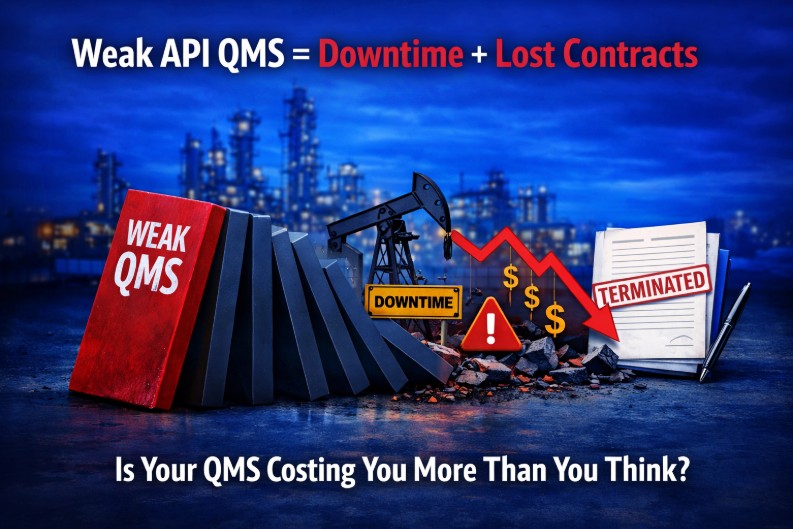
The Hidden Cost of a Weak API QMS
In the oil & gas sector, a weak API Quality Management System (QMS) is not just a compliance issue—it’s a direct threat to operational continuity and contract stability.
Companies often underestimate how gaps in their API QMS can lead to:
- Unplanned operational downtime
- Costly service disruptions
- Increased contractual penalties
- Loss of client trust and future business
This blog explores how weak API QMS systems silently increase risk—and what you can do to prevent it.
What Defines a Weak API QMS System?
A weak API QMS typically shows signs of poor implementation, not just poor documentation.
Common Indicators
- Lack of risk-based thinking
- Inconsistent process execution across projects
- Poor supplier quality control
- Weak corrective and preventive action (CAPA) systems
- Limited performance monitoring and KPIs
- Audit findings that keep repeating
These gaps create a fragile system that fails under real operational pressure.
1. Increased Downtime Due to Process Failures
A poorly implemented API QMS leads to frequent process breakdowns, which directly impact operations.
How It Happens:
- Unclear procedures lead to execution errors
- Lack of standardization causes rework and delays
- Poor maintenance planning results in equipment failures
Real Impact:
- Delayed project timelines
- Increased operational costs
- Reduced asset utilization
In upstream operations, even a few hours of downtime can cost millions.
2. Ineffective Risk Management = Operational Disruptions
Both API Q1 and API Q2 emphasize risk-based thinking, yet many companies fail to implement it properly.
Common Gaps
- No structured risk identification process
- Missing contingency planning
- Reactive instead of proactive decision-making
Result:
- Unexpected failures during critical operations
- Inability to respond to field challenges
- Increased safety and environmental risks
Weak risk management turns small issues into major operational disruptions.
3. Poor Supplier Control Leads to Critical Failures
Your QMS is only as strong as your supplier quality management.
Weak QMS Symptoms:
- No proper supplier qualification process
- Lack of inspection and verification controls
- Poor tracking of supplier performance
Consequences:
- Use of non-conforming materials or equipment
- Increased field failures
- Costly replacements and delays
Supplier-related failures are one of the top causes of downtime in oilfield services.
4. Recurring Nonconformities & Audit Failures
A weak API QMS struggles with closing audit findings effectively.
Typical Issues:
- Superficial root cause analysis
- Temporary fixes instead of permanent solutions
- Lack of follow-up on corrective actions
Business Impact:
- Repeated audit failures
- Delayed certification or suspension
- Increased scrutiny from clients
This directly affects your credibility in competitive bidding processes.
5. Contractual Risk & Revenue Loss
Oil & gas contracts are heavily tied to quality, performance, and compliance.
Weak QMS Leads To:
- Failure to meet service-level agreements (SLAs)
- Increased penalties and liquidated damages
- Contract termination risks
Long-Term Impact:
- Loss of high-value contracts
- Reduced chances in future tenders
- Damage to brand reputation
In many cases, a weak QMS doesn’t just cost money—it costs business survival.
6. Lack of Performance Visibility and Decision Control
Without a strong API QMS, organizations lack data-driven insights.
Missing Elements:
- Defined quality KPIs
- Real-time monitoring systems
- Structured management review processes
Result:
- Poor decision-making
- Delayed response to issues
- Inefficient resource allocation
You cannot improve what you don’t measure.
How to Strengthen Your API QMS and Reduce Risk
To prevent downtime and contract loss, companies must move from compliance-driven QMS to performance-driven QMS.
Key Actions
1. Implement Risk-Based Thinking Across All Processes
- Integrate risk assessment into operations, procurement, and project execution
2. Strengthen Supplier Quality Management
- Develop robust supplier qualification and monitoring systems
3. Build an Effective CAPA System
- Focus on root cause elimination, not temporary fixes
4. Standardize and Digitize Processes
- Ensure consistency and real-time visibility using digital tools
5. Conduct Regular Internal Audits & Mock Assessments
- Identify gaps before they impact operations or audits
How Vegas Consulting Helps You Eliminate QMS Weaknesses
At Vegas Consulting, we help oilfield service companies transform weak QMS systems into high-performance, audit-ready frameworks.
Our Approach:
- End-to-end API Q1 & Q2 implementation and recovery
- Advanced risk management integration
- AI-powered monitoring via Vegas Connit platform
- Proven 95%+ first-attempt certification success rate
What You Achieve:
✔ Reduced downtime
✔ Stronger contract compliance
✔ Improved operational efficiency
✔ Higher client confidence
Final Thoughts: Strong QMS = Strong Business
A weak API QMS is a silent risk multiplier—it increases downtime, disrupts operations, and puts contracts at risk.
On the other hand, a strong QMS becomes a competitive advantage, enabling:
- Reliable operations
- Consistent service delivery
- Long-term contract success
The choice is simple:
Fix your QMS before it starts costing you contracts.